Best Areas to Stay in Hong Kong With Family
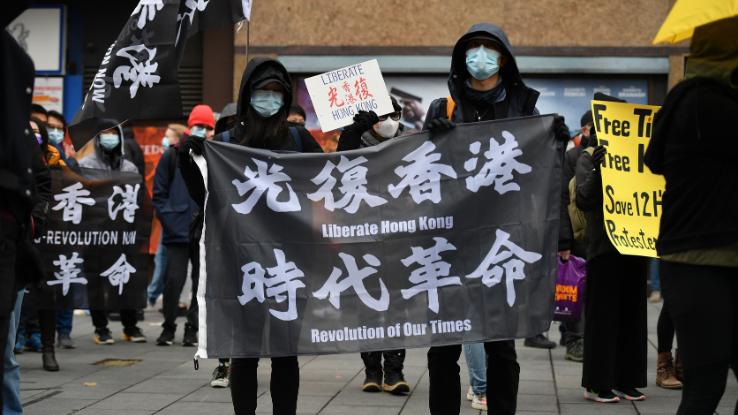
Hong Kong has a long history of protestors fighting for autonomy and cocky-decision, but, nether both the United Kingdom and Prc, Hong Kong and its people have struggled to become a democracy. Currently, Hong Kong is designated equally a "special administrative region" of Mainland china. In theory, this means a big degree of autonomy from mainland China under the "1 Land, Two Systems" policy. However, the primal phrase hither is in theory.
On June 30, 2020, a new security police force has clouded that autonomy: No simply is it no longer clear if Hong Kong can determine its own policies carve up from Beijing, but the new police gives China the power to extradite any Hong Kong citizen with trivial to no crusade. To understand its current crisis with China, it'south essential to reflect on Hong Kong'south complex history — and the mode that history continues to reverberate in 2021.
British Colonial Rule Overtakes Hong Kong
Later the first Opium War, Mainland china ceded the island of Hong Kong to United kingdom of great britain and northern ireland. In 1860 and 1898 respectively, additional territories — known today as the Kowloon Peninsula and the New Territories — were ceded to the British. From so on, the British colonized Hong Kong, enacting racist and white supremacist policies accordingly, including banning the utilise of the Chinese language in government and creating segregated European-only neighborhoods that were subject to different laws.
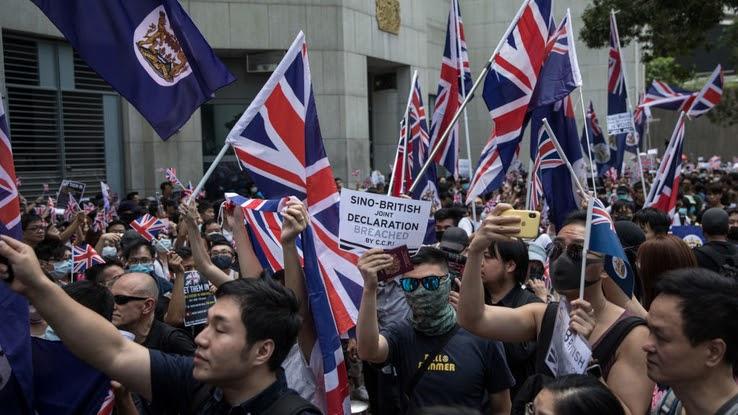
Declassified documents testify that pressure from Chinese leaders fabricated it articulate that the People's Republic of China would invade Hong Kong if it attained self-dominion. For example, in 1958, Premier Zhou Enlai chosen any attempt to bring democracy to the isle "a very unfriendly act." That is, despite enjoying the benefits of having a wealthy and economically stiff neighbor like Hong Kong, Prc viewed the prospect of republic in Hong Kong as a pace toward independence rather than reunification with China.
Nonetheless, folks living in Hong Kong pushed for reform and liberty from decades of colonial dominion. In the 1960s and '70s, protests over labor conditions eventually led to a college standard of living and pressured the colonizers to revoke racist laws. Encouraged by these successes, Hong Kongers exercised their freedom of speech, protested and held communist rallies in the open.
While some Hong Kongers were optimistic well-nigh reunification with China, others, especially students, worried that China would try to take away Hong Kong's freedoms instead of preserving the "1 Country, Two Systems" policy. These fears increased afterward the 1989 Tiananmen Square massacre — a violent crackdown against pro-democracy protests in Communist china that caused hundreds or thousands of deaths.
Nonetheless, later on more a decade of negotiations and preparation, Hong Kong was returned to China on July 1st, 1997. Nether the deal, Hong Kong was guaranteed autonomy until 2047. During that fourth dimension, the Basic Police force, a miniature constitution agreed upon past Cathay and the United Kingdom, was to exist the law of the land in Hong Kong.
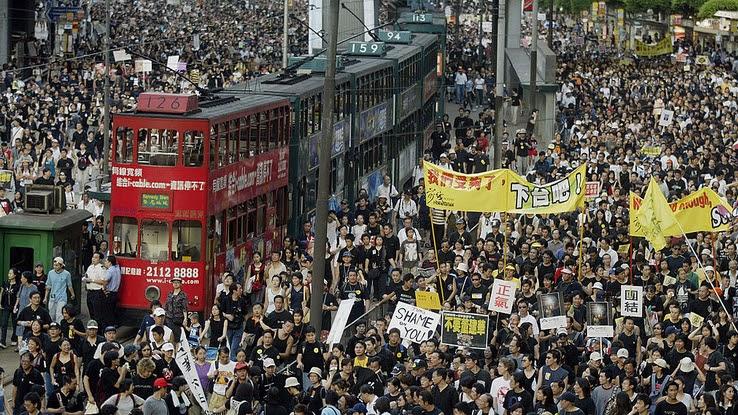
In 2003, an attempt was made to pass a law that would brand secession, sedition, subversion or treason against the Chinese government illegal. This triggered the first major protests against the Chinese government, with 500,000 people turning out on July 1 to express their outrage. Ultimately, the legislation was shelved — at to the lowest degree for a time.
Communist china'south Attempts to Change Education in Hong Kong
In the years that followed the 2003 protests, the Chinese Communist Party (CCP) promised autonomous reforms in the futurity. And, although a few alterations were made to Hong Kong'southward legislature, little actually changed — at least, not the direction many Hong Kongers hoped.
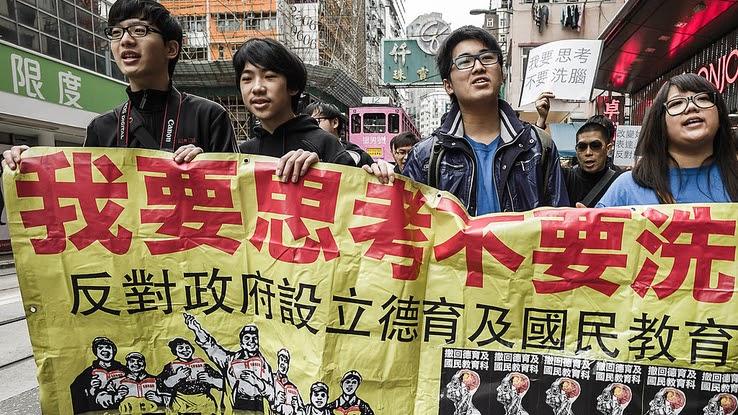
In 2012, attempts were made to change the curriculum of Hong Kong's schools to focus more on Chinese history and identity. This was seen by many Hong Kongers equally an attempt to feed younger generations propaganda about red china. Massive protests broke out, with secondary school students (roughly equivalent to American middle and loftier schoolers) leading the protest through a group called Scholarism. Hong Kong'due south master executive at the time appear that implementing the curriculum would be optional, rendering China's educational plan powerless.
The Umbrella Revolution Grips the World
Even though it was ultimately unsuccessful, the Umbrella Revolution is perhaps the most iconic of Hong Kong's protests. It was sparked by fears that the Chinese regime did non intend to keep a promise to create universal suffrage for the city's executive officeholder by 2017. Protestors demanded the resignation of the current pro-Beijing executive officeholder and balloter reform, but they had difficulty like-minded on the specifics of the latter need.
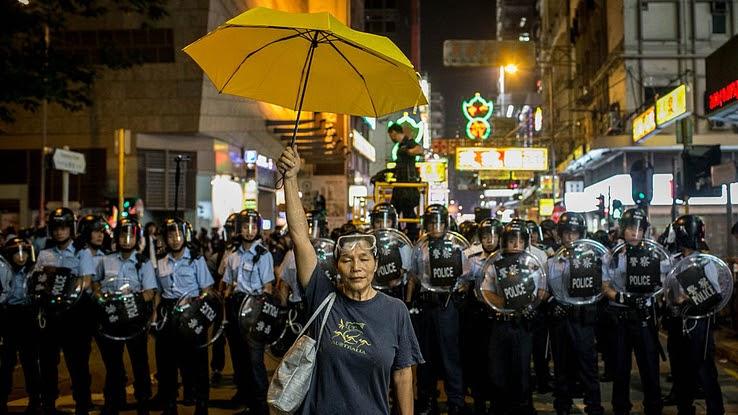
The protests were some of the nearly violent and cluttered since the 1960s, with the protestors' utilise of umbrellas to deflect tear gas canisters giving the movement its name. Additionally, the protestors gained international attending for sharing free food with each other and setting up recycling stations to keep streets clean. Somewhen, the protests were done in by an inability to unify around a unmarried set of demands and the return of many educatee protestors to school. Nonetheless, the protests permanently strained relations between the people of Hong Kong and mainland China.
Cathay Introduces the Hong Kong Security Law
Afterward the Umbrella Revolution, protests became much more mutual, with more being held in response to a crackdown on unlicensed food vendors as well as the first-ever rally for Hong Kong independence in 2016. In 2019, a new national security law was introduced, one that, if passed, would extradite Hong Kong citizens suspected of criminal activeness on the mainland to Cathay without a trial.
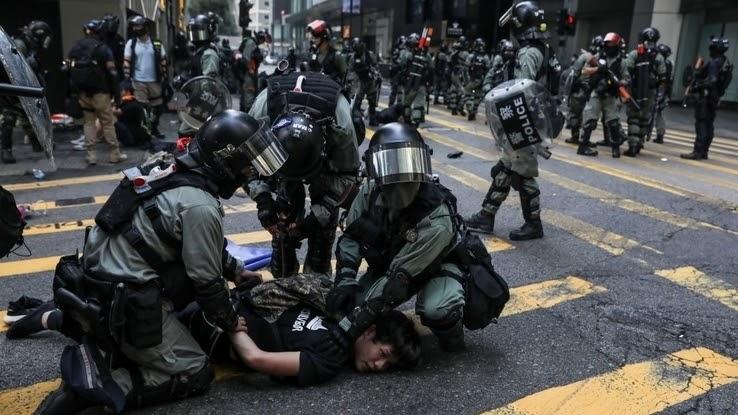
Protests bankrupt out quickly, swelling to massive numbers when Chief Executive Carrie Lam amended the law to also allow extradition to Communist china for criminal charges. In fact, the protests marked the "biggest political crisis in decades" and, according to Reuters, "pose the most serious popular claiming to China's President 11 Jinping since he came to power." Although Carrie Lam announced on June 15, 2019 that the law would exist delayed indefinitely, protestors argued that the law could still exist implemented at any time and refused to disperse.
Prc Makes Protest About Incommunicable for the People of Hong Kong
From there, the protests became a broader pro-republic motion. Police violence confronting protestors escalated — and law enforcement was suspected of colluding with triad street gangs to assault and intimidate protestors. Eventually, Beijing intervened directly by passing a new security nib. Protestors, the United Kingdom and a myriad of other countries competition the legality of this motion, merely there's little anyone can practise to oppose the Chinese legislation, which allows for the extradition of Hong Kong citizens to China and lifetime prison house sentences for those folks charged with secession, subversion, terrorism and collusion.
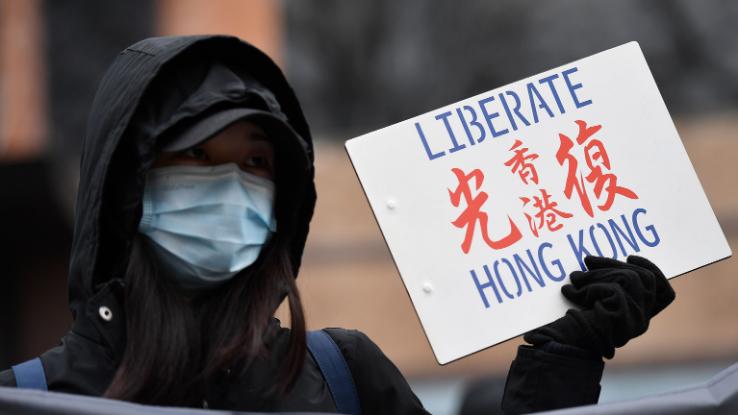
Additionally, the law likewise grants China and the Beijing-backed principal executive a range of new powers, including wire borer, closed-door trials, the ability to engage new judges in national security trials and more. Many kinds of protestation now count every bit secession, subversion, terrorism or collusion, including devastation of property. The law went into outcome just before July one, the anniversary of Hong Kong's handover to Prc. Since then, police have shutdown whatever attempted protests — even though protests and rallies are traditionally held on July one — and, in addition to making mass arrests, have used tear gas and rubber bullets against Hong Kong citizens.
In response, Hong Kongers have begun deleting social media posts and destroying pro-democracy signs out of fear of extradition. In effort to aid Hong Kongers, the Uk promised a path to citizenship for iii million Hong Kongers — and Taiwan, Australia and the United States have too fabricated moves to help people from the city who may soon demand to seek political aviary. Whether this severe plough of events marks the end of the fight for self determination in Hong Kong or non, it's clear that the new police force has irrevocably upended life for the people of Hong Kong.
lombardotheirried.blogspot.com
Source: https://www.reference.com/history/hong-kong-relationship-china-c6dcc7ea8a2fabdc?utm_content=params%3Ao%3D740005%26ad%3DdirN%26qo%3DserpIndex
0 Response to "Best Areas to Stay in Hong Kong With Family"
Post a Comment